Most of the times the comfort zone is mentioned in articles related to training, it is about leaving it, getting out of it.
While I agree that you miss a lot if you always stay in the middle of your comfort zone, I still want to make a stand for it!
First I want to argue that it is important where exactly “out of the comfort zone” one wants to go.
Second I want to give reasons to spend time in the comfort zone.
Not only one “out of the comfort zone”
So I do agree. Magic can happen when you seek the discomfort. If you do not visit your borders now and then, the borders will eventually visit you, meaning your comfort zone will shrink.
But it makes a difference how you leave your comfort zone. There is not only one “out of you comfort zone”.
As Tom Senninger pointed out in his book “Abenteuer leiten, in Abenteuern lernen”, there are two zones outside the comfort zone:
- The learning zone (aka growth zone)
- The panic zone
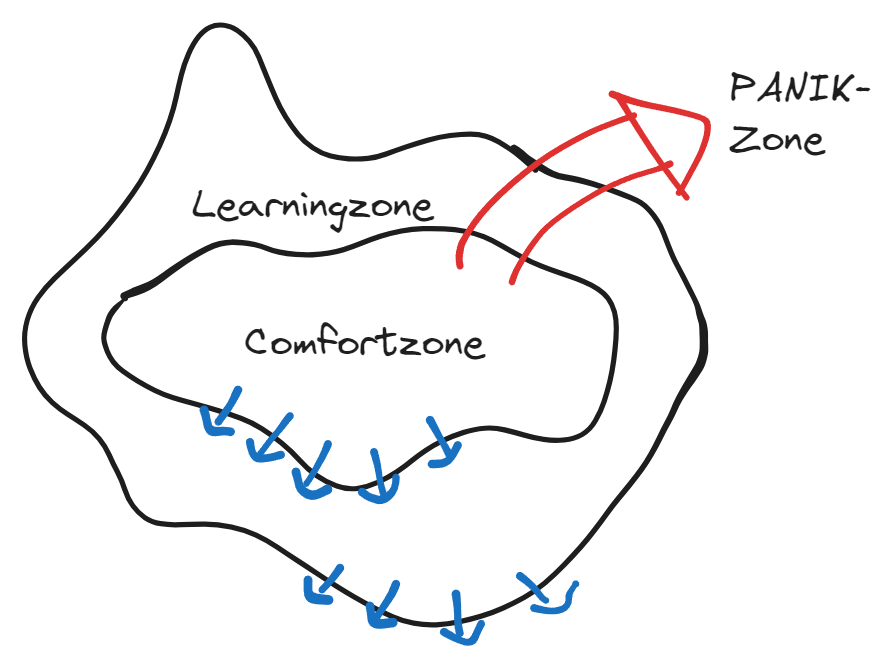
The learning zone
The learning zone is where you want to go to. It is a bit uncomfortable, but you have the tools and skills to grow in it.
So this is what all the memes and life coaches mean when talking about “where the magic happens”.
The panic zone
The panic zone is where the damage is higher than the benefit. Imagine you are doing squats with 100kg normally. If someday you do 105kg, this may be your learning zone. It is heavy, but you can do it and after a few weeks the 100kg from before feel easy. But if for some reason someone with 100kg climbs on your back while you train, you would most probably be severely hurt and start with a much lower weight months later. This is the panic zone. No way to learn from it. You may be able to adapt to things in the panic zone too, but at the price of short- or long term injuries, both physically and mentally.
How to work with the learning zone
The key to work effectively in the learning zone is to remove all stressors except the ones you want. If you do something scary, make sure you feel save otherwise. That you are healthy, that you are with people you trust, that you know what to expect, that you are curious and open for adventure. Taking a calculated risk is the phrase that describes it best.I will write more about this in another article.
Expanding the comfort zone
Going to the edge of your comfort zone is not an end to itself. It is a means to get to know the no-mans-land in the edge of your comfort zone. To make a map of it and eventually integrate it so that you feel at home – your comfort zone.In the end is the goal of all training to reduce stress. But if the training itself causes constant stress, there is something wrong.
Being in the comfort zone is important!
The comfort zone is not a bad thing. Only in the comfort zone is your parasympathetic nervous system predominant, your immune system fully engaged, your prefrontal cortex fully activated.
This is the only place you can regenerate, reflect, think deeply, be creative. It needs a feeling of safety to make that possible.
Growth happens in your comfort zone
Now this sounds strange. But in the same way you only get stronger from strength training if you regenerate afterwards can you only grow mentally if you have a safe place after an experience.
A home, a stable place to start from, have adventures and come back to. Especially if you want to train something over many years it is important to feel at home and safe with most parts of it. If you are always uneasy this will not work so well.
Some people get stressed as soon they realize they are in the comfort zone. If you are one of them, be careful and question this feeling!
If relaxing stresses you, something is wrong!
Train to spend time in the comfort zone
The comfort zone can feel boring. It can feel less “alive” as the state you are in in the learning zone. It is important to be able to come to rest. To stand still and stable. This is all the more important the further you were outside your comfort zone. To reflect, the catch up with your experiences.
Summary
So, to sum it up, it is not all about leaving your comfort zone. It is also about expanding it, getting to know it, scratching on its edges and enjoy coming back to it. Appreciating it and allow yourself to fully recover before the next adventure.
 Train Joy