Usually, when I read about extending the comfort zone, it is about getting tougher.
Shift the sensation spectrum vs. broadening it
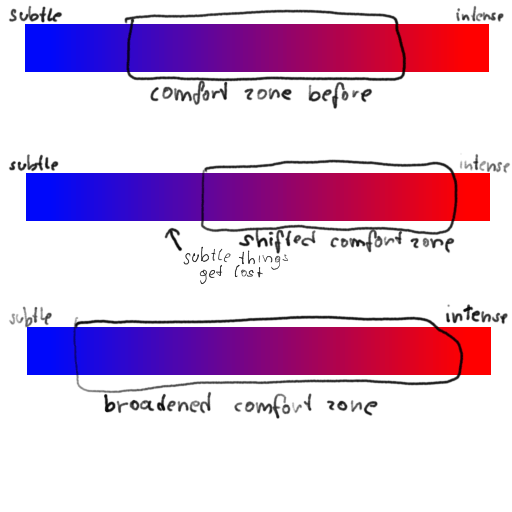
But if getting tough just means pushing the pain threshold up bit by bit, you become more and more numb for the more subtle sensations, which often are the source of joy in training.
So how is it possible to push the boundaries on one end while staying sensitive on the other end?
Well, it all depends on how you push the boundaries!
- Do you do it in a self-destructive or self-loving manner?
- Do you leave your comfort zone in order to gain freedom or to escape pain?
- Do you love what you do and embrace all the sensations that come with it or try to avoid them and wait until its over?
One key is to train yourself to stay mindful and open while being at the edge of your capabilities.
Step 1: Maintain the connection
The most important thing is to maintain the connection to your sensations.
Do not leave yourself behind, do not detach yourself from what you experience. Even if it is unpleasant.
Often this means reducing the intensity a bit, at least at the beginning.
And then, when fully “in-tune”, you can ramp up the intensity again.
But steer clear of everything that numbs you. No “eyes shut and go for it”. Embrace whatever feeling or sensation arises.
It helps to think “follow through” instead of “persevere”.
Step 2: Watch out for the hidden joys
In every activity, in every situation there are subtle beautiful things that get overlooked. Also, and especially at the edge of the physical abilities.
- The cool wind when running fast in the heat.
- The quietness when diving.
- The short moment of weightlessness when jumping.
- The feeling of balance and tension when lifting.
Let yourself be pulled into intensity
The better you are conditioned to perceive these subtle things, the more you can let yourself be pulled into intensity instead of pushing yourself into.
Of course sometimes you have to push the pain threshold in one area in order to feel a subtle sensation in another area.
How to do this in your everyday training?
There is a list of tools to include here, but I want to repeat the two which are most successful for me.
Tool 1: Observation Break
Stop doing what you do, check your physical and mental status and enjoy a short moment to hear the heart beat, the breath. Enjoy the way back to the comfort zone intentionally.

Tool 2: Keep mindfulness
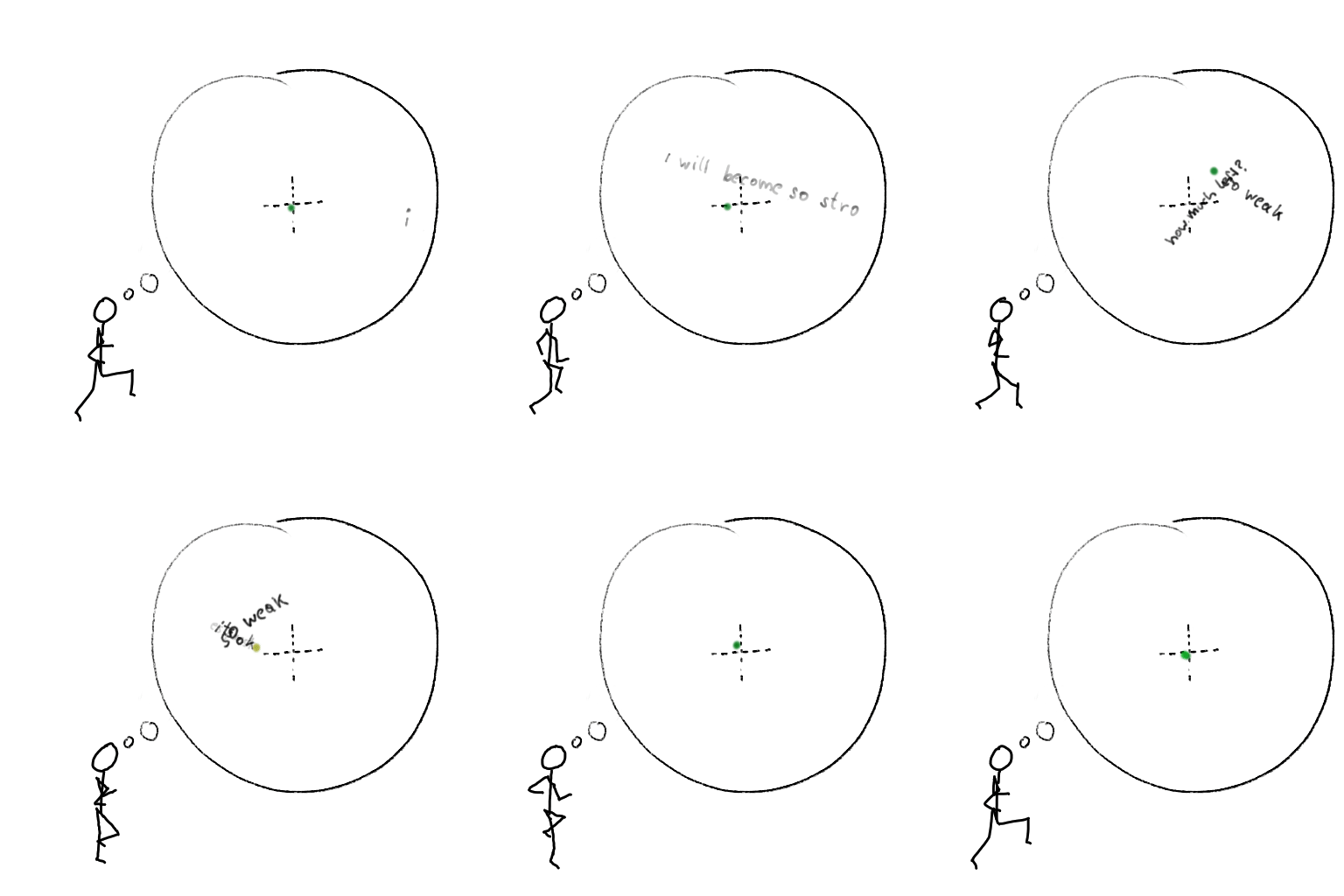
When you are forced to do something where you can’t stop or do breaks. Your only chance here is to stay in the mode of mindfulness as good as possible. You may have noticed that while it gets difficult quickly, there comes a “second breath” after a while. When you can reach a “stable state” at a higher level of effort. And use your hard breath or the alternation of contraction and relaxation as anchor. Don’t be disappointed if it doesn’t work on first try, it requires practice and depends on daily condition. It is really important here (and an important habit to build) to stay your friend. Meaning use all your conscious attention to care for you, to encourage you, to support you. Sounds weird?
Takeaways
- Push yourself in a curious, open manner.
- Train yourself to notice what happens without judging it.
- Let yourself be pulled instead of pushing.
 Train Joy