As a kid, I was very sensitive. I was sensitive to the cold, not able to do snowball battles without gloves, I quickly came out of my comfort zone when wrestling, both because I was scared and because of pain.
As an adult now I am, well, not one of the super tough ones, but well prepared for the challenges, adventures and joys of life in most circumstances.
How did this happen?
In hindsight, there were two ways I got there, which I used for different areas: Deliberate exposure and carrier activities.
Carrier activities

This happens when the joy in the activity you are doing is greater that the unpleasant sensations that come with it.
This happens for example when.
- The exhaustion when climbing a mountain does not have a chance against the view and joy of climbing and the feeling of being with friends.
- The fear of deep water has no chance against the awe experienced in the silence while diving.
- The stress of lifting a heavy weight has no chance against the feeling of strength when doing it.
- The fear of height does not have a chance against the flow of climbing.
- The exhaustion when playing soccer has no chance against the pure joy of playing in a team.
- …
In the good case: just go with the flow
If you have activities which include unpleasant sensations but you enjoy them anyway because of your passion for it -> go for it. Do not overthink it. As long as you do it you will develop toughness in a much faster pace than with any deliberate training.
It seems to me that the good case happened when the skills required played well with my strengths. They got developed with not much intentional effort.
In the bad case: Debug your experience
If you have activities with the potential to be joyful, but you just cannot enjoy them, try to dissect your experience.
Is there something you are afraid of, is there a sensation, a feeling or a thought that is so strong that it obscures everything else?
Do you feel weak, clumsy, experience pain or fear?
If yes, try to see it isolated from the rest of the activity.
It is important that the ratio of “unpleasant sensation” vs “joyful activity” is right.
Again, there are two possibilites to regulate this:
- Can you lower this joy-blocker for a while until you got used to it? Either by wearing protective clothing, help from friends or other temporary assistances? Its important to leave your pride behind. After all its about joy in life!
- Can you train it up until it no longer prevents you from enjoying life? This leads to “Deliberate exposure”.
Deliberate exposure
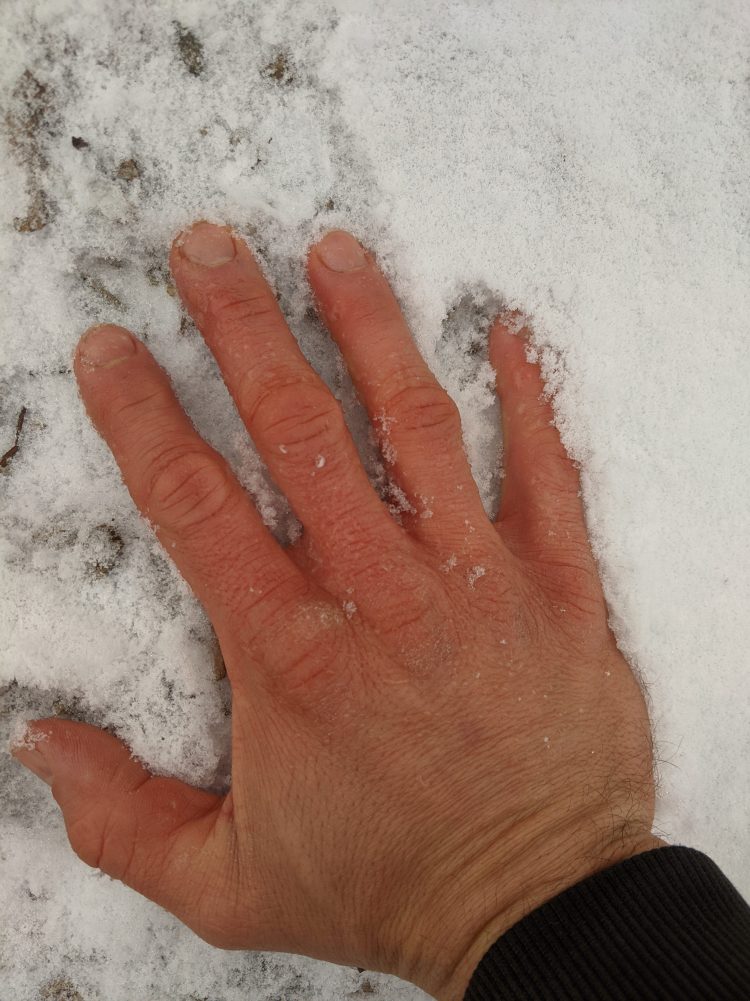
This is something I used in areas where a weakness prevented me from enjoying so many otherwise great activities.
For example the aforementioned cold sensitivity.
I started with cold baths, trained without gloves as much as possible, slowly building up the time I managed to cope with it.
I made the experience that it gets better as soon as the body was working heavily. In the first 5 minutes of running I was always sure that I would not be able to persevere, but I never came home with cold fingers.
I made the experience that the adaption accelerates if I alternate between comfort zone and cold. Making push-ups in the snow until it hurts, putting on thick gloves and running until the fingers glow, and going to push-ups again.
An example of a training like this is described here
And I made the experience that this kind of deliberate training reduced fear and enabled a lot of freedom
If, and this is key: if I do not overdo it. If I trained until I felt sick of pain I had no motivation to go near the end of my abilities the next time.
Important:
- Do deliberate exposure with a purpose, and out of self-love (“I want to enjoy skiing” instead of “I am a weak and spoiled”).
- Increase load gradually and intentionally as with every other training. Have patience.
- Make the experience that it works and build experience after experience.
- Stay curious. “What happens if I try this?” Play and dance with the challenge. It does not have to be the limit every time. Consistency is more important.
It seems to me that I needed deliberate exposure in circumstances where the skills required caught me on a weakness. Something that I had not much natural talent so that I had to pay special attention to keep it from influencing my ability to enjoy.
For me these were
- cold resistance
- spatial orientation
- grip strength
- throwing
Takeaways
- Getting tough does not have to be a bootcamp. It can be and mostly is a gradual process that happens naturally if you stay curious and scratch a bit on your comfort zone.
- It is not only for the relentless, but a great tool for everyone to increase the range of joyful activities.
- If you can develop skills with a stimulating carrier activity, go for it. If a weakness prevents you from participating in these activities, address it seperately.
 Train Joy
One thought on “How to get tough”