In this article I describe the “workload” as training, but it can be any physically strenuous activity. This is still work in progress, especially the “Berzerk mode”.
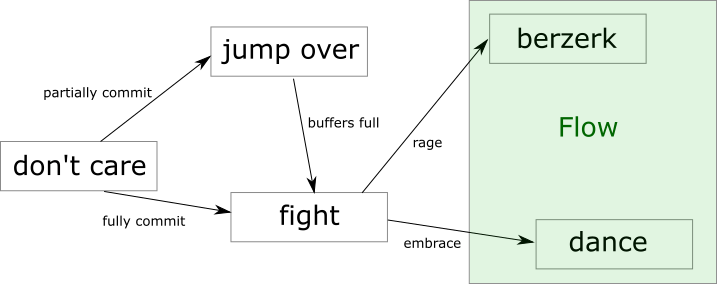
Not committing / don’t care
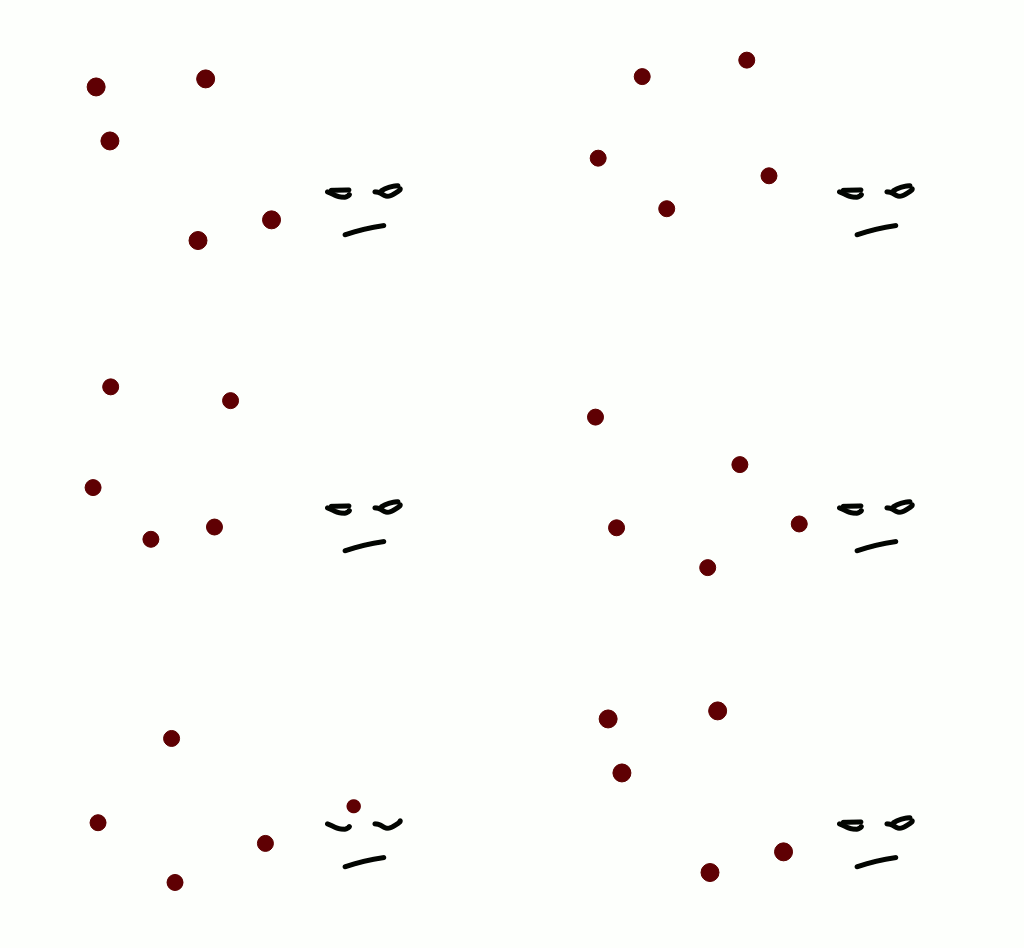
If you just don’t care, don’t want to strain yourself. You do the training because you have to or because it is in your schedule but there is no intrinsic motivation behind it. You don’t really “feel in”, think about something else, wait for it to be over. You sit through it.
This is usually not very joyful and the performance will be quite bad (although maybe it is possible to start in this state and switch to another one later…). Not caring protects you from pain (a bit), but not from suffering.
Generally I consider it a bad choice to do things in this state (usually it means that no choice was taken – neither the choice to do what you do nor the choice to not doing it). It creates bad thinking and feeling habits and is a rather passive and unempowered experience.
Many of us know this state from school or a boring job, where you just get dragged along.
It is worth noticing that when you find yourself in this state often than usual, it might be a sign that you are low on power and are here as a protection from loosing even more energy.
Jump over it
You made the choice to do the training with all you can but for whatever reason (fear, distraction,…) you don’t want to feel all there is to feel. Your eyes (the inner and the outer) are shut. There is still an element of “wait to get over” in this, but much more active, much more aggressive than in the “don’t commit” state.
An example is, if you want to swim in cold water, that you jump in screaming, gasping. You swim through it as fast as possible (swearing loudly), come out and get dressed as quickly as possible.
This can work well for shorter amounts of time with activities which require no coordinative mastery . You made a clear choice, that gives a lot of energy (and/or adrenaline). Sometimes, especially in emergency situations, it’s helpful to be able to reach that state. E.g if you have to lift or carry something heavy.
Drawbacks are that you won’t reach your full potential (technique will be sub-optimal), that you don’t fully “live” through it (you will not remember much) and you might get yourself hurt without noticing before- physically or emotionally.
Fight
You made the choice to do the training with all you can. You made the choice to (or are forced to, because the time is too long to jump over it) feel what is to feel, may it be pain, exhaustion, cold, heat, doubts,…
Since you made the decision to do it, you fight what comes between you and the training. You keep a stiff upper lip, you march through it.
This state can feel very bad while doing it. You don’t protect yourself from the pain, you don’t protect yourself from suffering. There is no way to fool yourself here, you see your limits clearly, can feel weak or disappointed. You are afraid of failing or not living up to expectations (be it your own or that of someone else). But you don’t let this stop you.
Despite your commitment, your performance might be suboptimal. Too much energy goes to fighting back the pain and the thoughts.
Many people I see train in this state, mixed with the “jump over it” state. Loud music or a yelling coach can improve performance sometimes.
But nevertheless it is sometimes necessary to go through this state to reach the next one.
James E. Loehr describes this state in his book “The new toughness training for sports” as the last obstacle to the “Ideal Performance State”. The key is facing and overcoming fear.
Flow States
The next two modes are modes where you come into a “flow state”. A state where you, by definition, loose most of your self-consciousness for a while, being fully immersed in an action.
Berzerk Mode
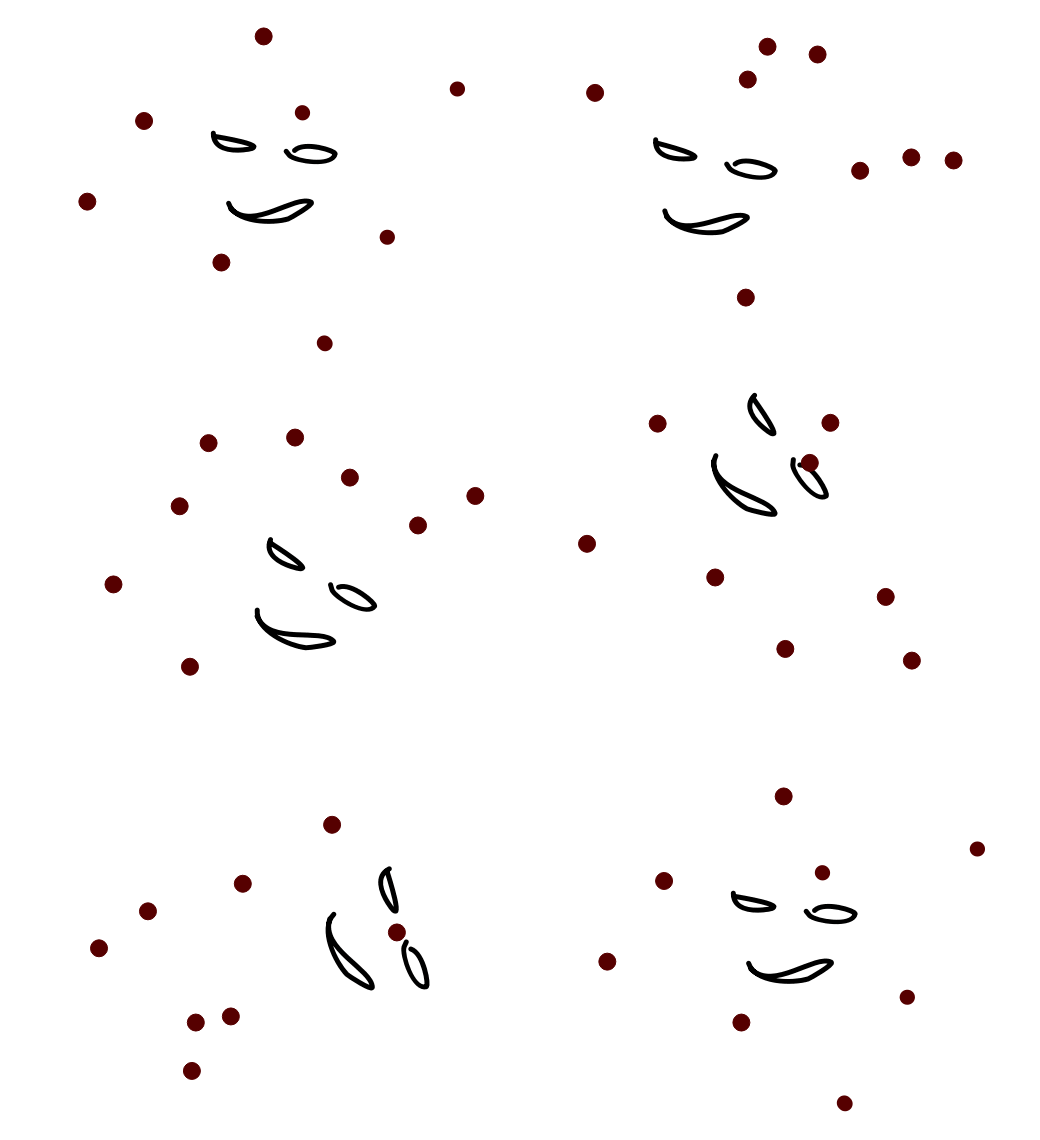
Unfortunately I haven’t found much on this state in literature.
It is a mode of ecstacy, very aggressive, very adrenaline-driven. You don’t feel much pain (and if you don’t care). You feel strong, almost invincible, and in fact, you have much more strength than in “normal” mode. This does, however, not hold for coordination.
You can get injured in this mode and not even realizing until the next day.
This mode is easier to enter when moving in rhythm with music or in synchronization or interaction with other people. In this case it is almost impossible to skip out of the rhythm, as if there was some power from outside which moves your body instead of your body moving itself.
Berzerk mode is certainly a great experience. I also consider it helpful to train it now and then, in order to be able to use it when necessary.
The drawbacks however are to be taken seriously. Injuries can happen. It is likely to go too far, for example in a fight, and harm others.
It is more the “dark side of the force” in Star Wars terms. But nevertheless, worth experiencing.
I assume it is what happens when animals stay in the flock or pack, although they are wounded or completely exhausted. I also assume it is the reason lock step is practiced so often in military.
Dance
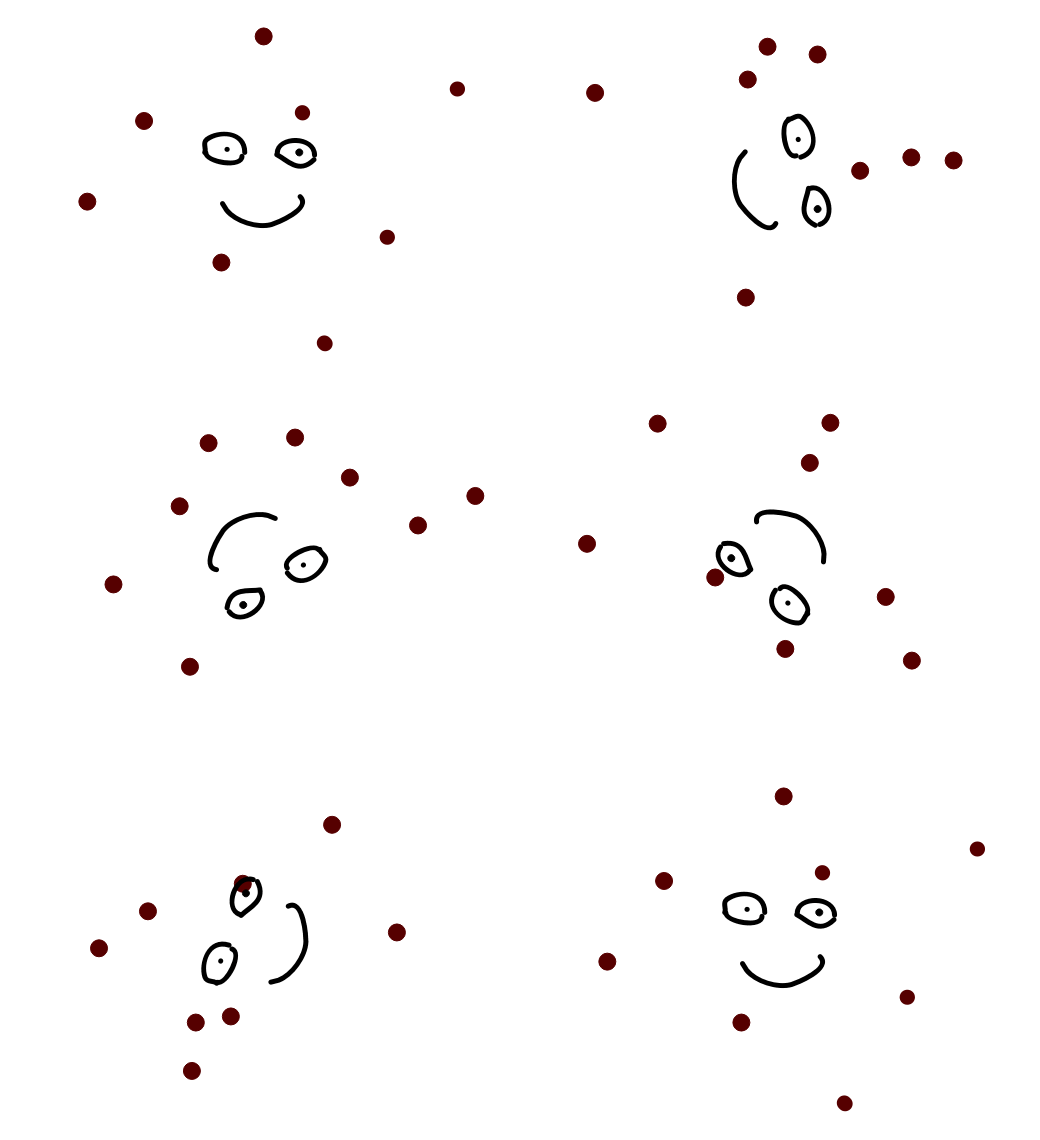
In this state something strange happens.
Your physical body (the thing that you can take pictures of), your perception of your body and the body you imagine, you control, are all very close to each other, synchronized (this is unfortunately often a misused word).
Perception: You have a broad perception, see clearly, feel your body, still feel your physical limits (muscles get soft, technique difficult to hold), perhaps even feel that there is pain. But it does not carry you away. Somehow all around you turns and flips, but you sit in the middle and are able to take care of things. Imagine a kid climbing on a comparatively high rig and you encourage it and hold the frame of safety at the same time.
This of course is not a static state (at least not for me). All the time you slip in and out of it. Different sensations and events try to get you spinning again.
When pain or some other sensation tries to pull you away, the reaction is not fight, but fully perceive it and accept it. And thus remove its power over you. Use the power to spin it around you, standing in quietness in the middle. Play with it. You are courious, interested in the sensation. Let it come closer and make it go a bit away. Thats why I call it Dance.
And this is the key: A wide-eyed couriosity, aliveness, awareness. It makes you quick enough to slide back into the area of balance whenever you get pushed or pulled out.
Remember, this all still happens at the edge of your physical ability. In hindsight it often feels “light”, you wonder if you could have “done more” or “wanted more”. Which, if you really danced, is a fallacy. There is a sweet spot in “wanting” and “pushing” which reaches your pyhsical potential. If you want even more, it gets harder and performance suffers. An example of this is studied with the Jamaikan Sprinter Asaffa Powell, in this case it is shown that he contracted too many muscles when falling out of the perfect state.
https://www.youtube.com/watch?v=_Qai-AjEA5I
Ways how I will try to get you there:
All these exercises have in common, that the path in direction of flow is more pleasant and the path in direction of fight is less pleasant than usual. Thus they serve as a kind of “amplifier” and give fast feedback in which direction you are going.
- Balance exercises (both balancing yourself and balancing a load) to train “concentration endurance”
- Cold exercises: e.g. cold water baths. Conscious observance of the inner processes when entering or staying in cold water allow to train and getting used to what happens under load – without much distraction. You don’t have to “do” much, all that comes, comes by itself.
- Apnoe exercises: Hold your breath, either with full or empty lungs. Grow a content, trusty relaxed state while doing this. Later do something while holding breath. Like the cold, this gives the opportunity to observe without much distraction. It also emphasizes that you don’t have to “do” anything, just watch.
- Start in a low-intensity/high awareness state and take that state with you while increasing intensity.
- Make you curious enough about an aspect of the high intensity so that you get pulled into it while maintaining the curiosity and thus the awareness.
Things that prevent entering this state:
- feeling observed and judged
- thinking about how good you once were or should be
- feeling weak or unsatisfied with your performance
- getting pushed without being really eager to do that.
 Train Joy